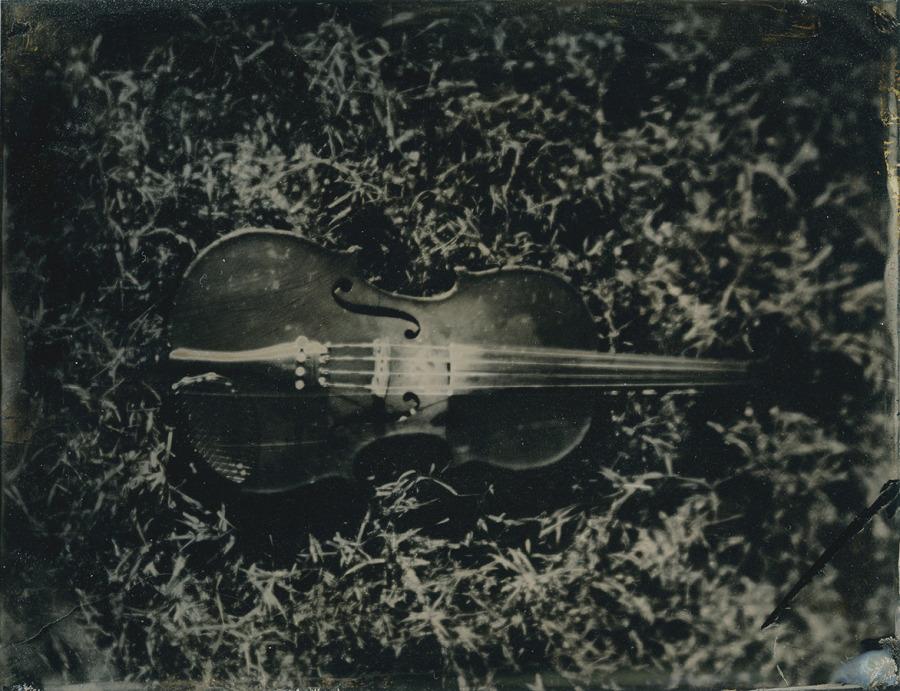
I'm in an analogue mood today, so I'm gonna hit you with some non-digitals. Some weeks ago I attended an awesome workshop, hosted at my friend Leah Sobsey's house, lead by Tim Telkamp, on wet plate photography. I won't get into too much detail on how it works, because I was barely able to grasp it over the course of the day, but suffice it to say, the process is as unlike digital photography as it can be. This is the grandfather of modern photography, the same process used by Civil War photographers and others before flexible film came along. In a nutshell, you create a layer of photo-sensitive chemicals on a piece of glass or metal, load the plate into a modified film holder, expose the plate, then develop and fix the exposed layer of collodion, similar to a paper print in the darkroom.
First, you prepare the shot. Still-life or live human, you set up your camera (we were using large format 4x5 and 8x10) and your subject before turning to the dirty work, because it becomes a time-sensitive process once the chemical bottles are open. You don't want to start thinking about your composition and trying to nail the focus on the back of the ground glass once you've poured the plate. Once the shot is set up, you head into the darkroom and pour collodion onto your plate. This part seems easy, but is not. It takes practice to get the thick syrupy fluid on the plate evenly, and all the way from edge to edge. It's easy to screw it up, and you get one chance at it. Once coated, you soak the plate in a silver bath for a determined time, 3-5 minutes, which makes the plate light-sensitive. Still under the safelight in the darkroom, you load this plate into a film holder that's been modified to fit the thickness of a plate of glass or tin. Once sealed in the light-tight film holder, you can go back outside and make the picture. And when I say outside, I mean that literally. The light-sensitivity of a wet plate is marginal compared to film; in full sun at wide open apertures we were still using gestimate shutter speeds in the one-second range (situations where I would routinely use shutter speeds over 1/2000 sec, at ISO 400). After the anti-climax of the exposure itself, you take the film plate back inside the darkroom and must now apply developer, another complicated pouring move that seems to require a helluva a lot of practice to get right. If the fluid pools and lingers in one spot for more than a second it will develop inconsistently. It's ridiculous how much of the process is based on estimation, manual dexterity, and luck. It makes you appreciate the skill and hours of practice the masters of the medium needed to have.
Once developed, you soak the plate in a fixer, either Sodium Thiosulfate or Cyanide. Yes, both deadly poisons. Fun times! Now you have a plate of glass with a gunky crude on it that forms an image. There's some washing in water and a drying period as well. With all that's involved, I had to hustle all day to create a whopping eight plates with my partner, four apiece. And all but one of my four outright sucked, for one reason or another, one flub or another, in the many opportunities for flubbery in this most un-digital of processes. That's the violin shot above. It was a really fun process though, and fascinating to learn about. A nearly dead art only a few years ago, there's been a resurgence of interest in it, and so the necessary chemicals and supplies are easier to find than ever before, though I would remind you, not for the faint of heart!
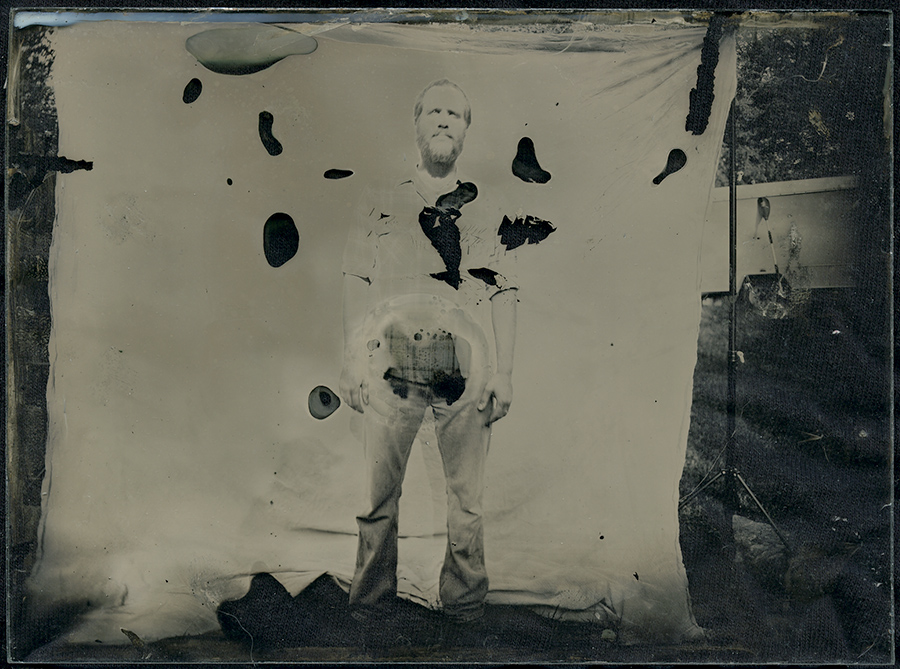
My last shot of the day almost came out good, but then somehow I ended up with the plate face-down in the final water-bath tray, which rubbed off some of the supple collodion layer. Like I said, lots of opportunities for flubbery. Other than being scanned in, these shots have not been manipulated. It takes a lot of work to make a digital photograph look this awesome in photoshop!
-llg